Legitimization of Conquest

Ceremonies of Possession in Europe’s Conquest of the New World, 1492-1640 by Patricia Seed

By Steven Knorr

As European powers expanded into the Americas, they used ceremony and ritual to cement their control over newly conquered lands. Perception of colonial ownership differed between the Portuguese, English, French and Spanish.

Ceremonies of Possession by Patricia Seed is a book that explains the rituals and ceremonies European colonizers performed when laying foundation for political authority over the New World between 1492 and 1640. Seed demonstrates that the Europeans did not behave as a monolith, but that each had their own customs and practices when establishing their overseas empires. According to Seed, the symbolic acts taken by the Europeans were based upon familiar gestures, actions, movements or speeches that they already understood[1]. Throughout the book she demonstrates how European legal codes can differentiate how legal possession can be interpreted differently.

Seed begins this discussion with the Portuguese claiming dominion over places they discovered.[2] To the Portuguese, simply discovering land meant they held dominion over it[3]. To the English however, to hold dominion over a territory meant there had to be an intent to stay by establishing houses and boundaries. Queen Elizabeth of England believed that the Portuguese had no dominion over places they simply had found[4]. The English established boundaries by putting up fences and hedges and building gardens. Full-time use of land was an important indicator of property to the English. For this reason, they were able to more easily disregard land usage by the Native Americans, as Native Americans only used theirs on a semi-permanent basis, according to the English laws.
Continue reading “Legitimization of Conquest”

Creoles in Louisiana History

Since their origins in the early 1700s, the Creole people of Louisiana have forged a unique identity for themselves in the American Southeast. 

by Steven Knorr

The world Creole has held many different meanings throughout its history of use. People called Creoles in the Americas adapted to the Louisiana Purchase and came to create a culture and identity of their own in the Southern United States. The word Creole is unique among American nomenclature, referring to a specific group of people with French ancestry in the South and in the Caribbean. The term is not applied to French Canadians, though sometimes the term can be used to refer to Spanish speaking people of mixed racial origin. While today many whites with French ancestry are known as Cajun in the Deep South, people of mixed-racial ancestry with French heritage often exclusively refer to themselves as Creole. The word Creole itself comes from the Portuguese word crioulo which means someone one who was raised in a house, especially a servant. This word was adopted by other European languages and by the 1500s the word crioulo (or the Spanish criollo) would specifically refer to someone “native to the colonies.”

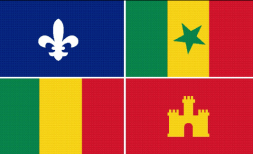
louisiana_creole_flag_2014-02-01_18-35
The Creole flag was designed in 1987, and represents the mixed heritage found in Creole culture. French language and tradition (top left), combined with west African ancestry (tri-colors of Senegal and Mali), with Spanish colonialism (Tower of Castile, lower right).

Origins of the Creole People

Louisiana was a difficult place for settlers in the 18th century. French exploration of the Mississippi delta was conducted by La Salle, who in 1682 proclaimed the region south of what is now Memphis Louisiane in honor of Louis XIV. French settlement first began with the creation of Fort Maurepas (modern Biloxi, Mississippi), and the region was soon given colonial governance. In 1722, four years after its founding, the city of New Orleans became the capital of French Louisiana. The governor general ruled both Upper Louisiana (Haute-Louisiane), the modern Midwest, and Lower Louisiana (Basse-Louisiane), the Mississippi drainage basin in what is now Arkansas, Mississippi, Alabama, and Louisiana. Settlers came from France, Canada, and the French West Indies.

Continue reading “Creoles in Louisiana History”

The Battle of Austerlitz: War of the Third Coalition

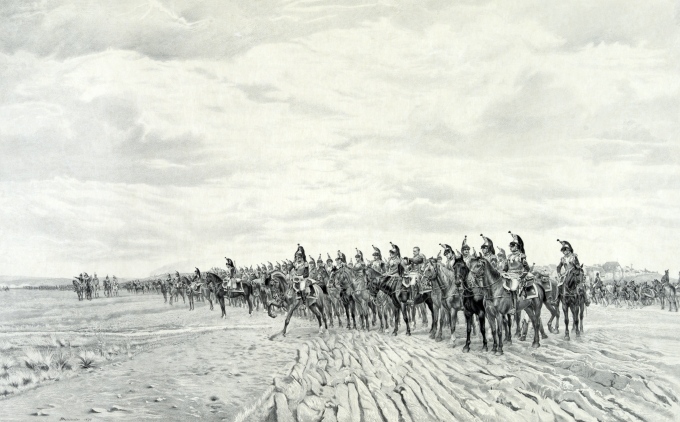
Jules Jacquet, Cuirassiers at Austerlitz (1874)

In a series of lightening campaigns against Austria and Russia, Napoleon led France to victory against overwhelming odds. The Battle of Austerlitz that occurred during the War of the Third Coalition (1803-1806) would forever change the shape of central Europe. 

By Steven Knorr

The Formation of the Third Coalition (August 1805 – December 1806)

Since 1792, France had been at war with all of the major powers of Europe; though peace had been made with each in turn, Great Britain held out the longest. In March 1802, the Treaty of Amiens ended the hostilities between the United Kingdom and France. Europe seemed at peace. But conflict arose quickly as the British and the Swedes made an agreement that would lead to the forming of the Third Coalition against France. Russia and Austria would also join this coalition; Austria in particular was keen on revenge after suffering embarrassing defeats and ceding territory in the First and Second Coalition wars. The first two coalitions were waged against revolutionary France; the Third Coalition however would mark the beginning of what is now known as the Napoleonic wars. In May 1803, before these alliances were finalized, the UK declared war on Napoleon’s France. By August 1805, Russia and Austria had joined in and all Europe was again at war.

1801-text6

Europe, 1803. Map made from template here.

Napoleon, French Emperor after 1804, developed ambitious plans for invading the British Isles. He assembled a massive invasion force around 200,000 men for the task. But with creation of the Third Coalition and threats looming on the continent, Napoleon abandoned his plans of invasion and turned his attention eastward. Though Napoleon discarded his invasion plan, all was not lost. French troops gained invaluable experience in the months of training that would prove to be of service in their upcoming campaign.

The Ulm Campaign (25 September – 20 October, 1805)

The Austrians moved towards France by concentrating their forces near the city of Ulm, at the time part of the Electorate of Bavaria, a state in the Holy Roman Empire. Karl Mack was the commander of the Austrian forces. He instituted reforms to the army on the eve of the war which would lead to insufficient officer training. This greatly hindered their military organization as officers did not have the proper training to coordinate troop movements. In the previous campaigns against the Austrians, the Italian theater became the primary focus for the French. The Austrians believed the French would focus heavily on Italy again and dispatched 95,000 troops into northern Italy and 72,000 into Ulm. The Austrians hoped with the heavily fortified and mountainous region of Ulm, they could hold out until Russian reinforcements arrived.

Continue reading “The Battle of Austerlitz: War of the Third Coalition”